

The NeuroCharacter Method
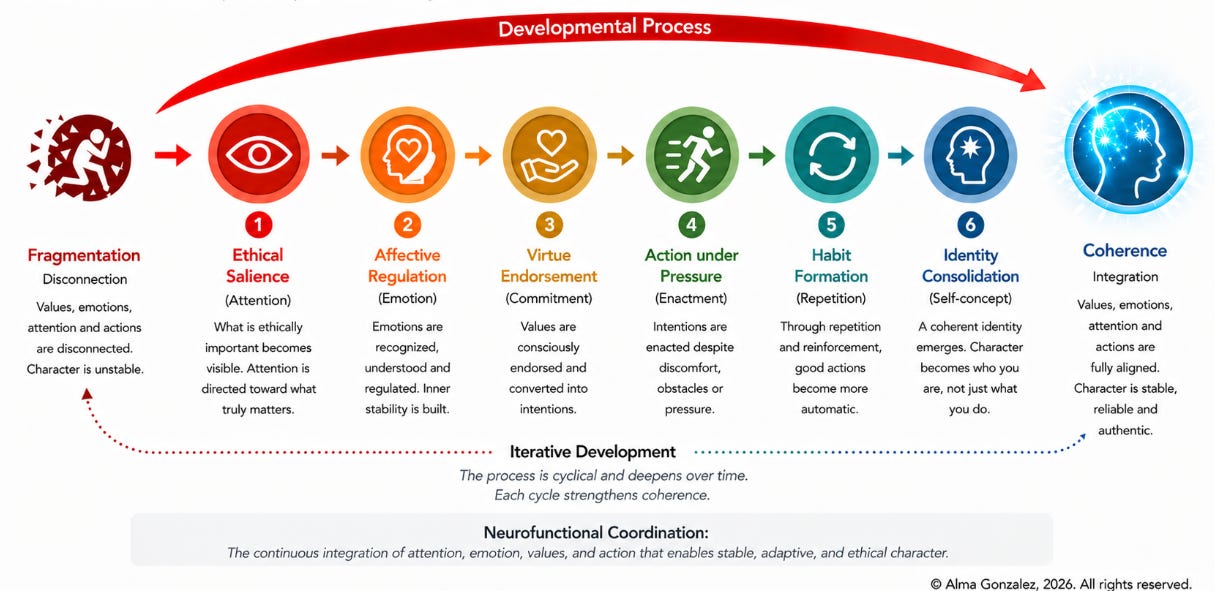
The NeuroCharacter™ Method addresses a persistent challenge in adult ethical development:
Why do capable leaders fail to act in accordance with what they endorse?
Leaders frequently articulate clear values, ethical commitments, and principled intentions. Yet under pressure—when emotional activation rises, competing incentives emerge, or institutional constraints intensify—alignment begins to destabilize.
Judgment may remain intact, but reliable enactment does not.
This inconsistency is often explained through concepts such as weak willpower, insufficient habituation, or flawed reasoning. While each captures part of the phenomenon, they do not fully explain why ethical inconsistency becomes most visible precisely when pressure increases.
The NeuroCharacter Method advances the thesis that ethical instability is a problem of fragmentation.
Stable ethical action depends on sustained coordination across the internal capacities that support action—attention, emotion, commitment, identity, and behavior.
When these capacities become decoupled:
attention narrows toward immediate demands
emotional reactivity intensifies
short-term pressures overshadow reflective commitments
habitual responses override principled intention
The problem is not the absence of values.
The problem is insufficient integration.
The NeuroCharacter Method describes reliable ethical agency as a function of neurofunctional coherence: the progressive alignment of attention, emotion, values, and action that makes virtuous conduct stable, reliable, and authentic.
A Six-Stage Developmental Process
At the core of the NeuroCharacter Method is a six-stage developmental process:
1. Ethical Salience
What is ethically important becomes visible. Attention is directed toward what is ethically significant.
2. Affective Regulation
Emotions are recognized, understood, and regulated so they support rather than disrupt virtuous action.
3. Virtue Endorsement
Values are consciously embraced as commitments and converted into intentional ethical purpose.
4. Action Under Pressure
Ethical intentions are enacted despite discomfort, ambiguity, competing incentives, or risk.
5. Habit Formation
Repeated aligned action strengthens reliability until virtuous conduct becomes increasingly natural and consistent.
6. Identity Consolidation
Character becomes integrated into professional identity—virtue becomes part of who one is, not merely what one does.
Through repeated cycles, development moves from fragmentation toward coherence.
Implications for Leadership Development
Modern organizations invest heavily in leadership competencies, compliance systems, and values-based initiatives. Yet ethical reliability remains fragile because inner coordination is often neglected.
Leadership development frequently strengthens capability without strengthening integration.
The NeuroCharacter Method reorients development toward ethical reliability by cultivating leaders whose attention, emotion, commitment, action, and identity remain coordinated when complexity intensifies.
The future of ethical leadership lies in becoming capable of reliably enacting what is right.
Individuals and organizations seeking to cultivate ethically reliable leadership are invited to explore how the NeuroCharacter Method can support their development journey.